


Fishpipe
INFRAPIPE manufactures the largest range of pipes suitable for fish passage in New Zealand, and reprocesses all production waste. Flexible thermoplastic pipes, also known as profile pipes, twin wall pipes or helical (spiral-wound) pipes are now the default choice globally for culverts. They are lighter, greener, cheaper, and easier to install than concrete or steel, and have a longer-life with no maintenance requirements. Now with the higher strengths available from INFRAPIPE they are also a highly effective substitute for box culverts, providing a shaped channel and the same load for a lower price and environmental impact.
Download more information:
- Request a Quote
- Call us: 09 869 3030
- Email: [email protected]
- Office: 3 Averton Place East Tamaki Auckland 2013
- INFRAPIPE is an New Zealand manufacturer of fully recyclable HDPE culverts using state of the art pipe making equipment.
- INFRAPIPE and its products are certified to the highest ISO standards, 9001:2015 and 5065:2005 ensuring the pipe is made with the best resin and will last a century or more.
- INFRAPIPE also uses design software to produce the most economical pipe for the load case, soil conditions, water table and hydraulic requirements.
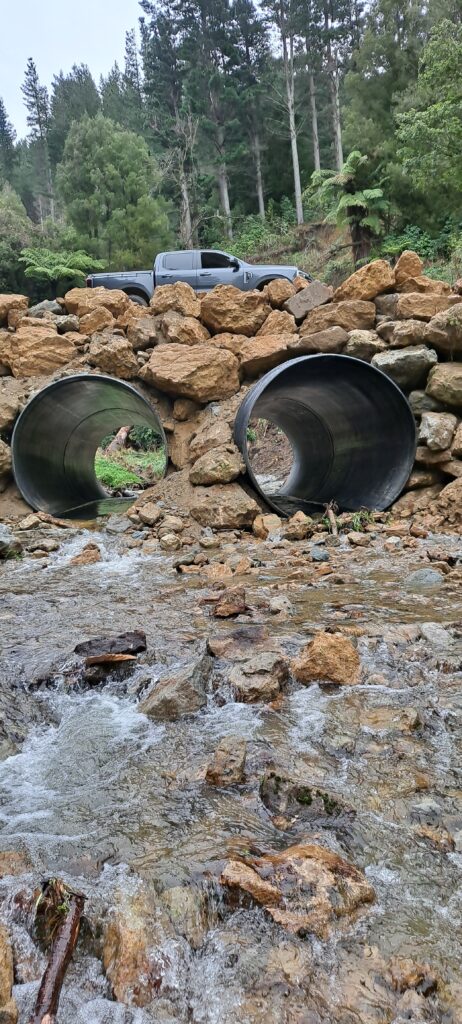
Features and Benefits of Recyclable INFRAPIPES
- Best seismic resistance
- 100-year life
- 14 times lighter (7%) than concrete
- Stronger
- Quick to install
- Completely recyclable
- Best hydraulic performance
- Easy to freight
- Best abrasion resistance
- Chemically inert
- Biologically immune
- No maintenance
- Easy to modify or repair
- Fish baffles fit permanently and quickly
Definitions/Abbreviations
Definition | Meaning |
BFW | Bank Full Width – The width of the stream area at a certain level, which for many installations must be exceeded by the Inner Diameter of the pipes chosen according to a given formula, the formula chosen being dictated by the size of the BFW. |
CSA | Cross-Sectional Area – the capacity of the pipe expressed as the area of the cross section of the inner pipe in mm2 |
DN | Nominal Diameter for INFRAPIPE this is the ID (Inner Diameter) Note for some competitive products DN is the OD (Outer diameter) |
Flow Rate | The volume of water in m³ which can/will travel through the pipe, a product of 1 - the water needing to flow through the pipe, 2 - the hydraulic efficiency (plastic pipes are 18% more efficient than concrete) 3 – the gradient and 4 – the cross sectional area (CSA) |
Flow Velocity | The speed in m/s at which the water will flow through the pipe for a given flow rate |
GWL | Ground Water Level – the depth of the Ground water in relation to the surface (RL) |
HDPE/PP | The plastics from which INFRAPIPE is made. They are completely chemically and biologically inert, non-polluting, fully recyclable and all production waste is reprocessed and reused. |
IL | Invert Level – the lowest level of the Pipe or river |
NES-FW | National Environmental Standards for Freshwater |
Rest Pool | An area that is deeper and slower than the flow would normally sustain, long enough and deep enough that it can accommodate local species |
SN | Ring Stiffness – the strength of the pipe, typically 4,8 or 16 but INFRAPIPE can engineer products from 2.5 to 40+ as required for the application. |
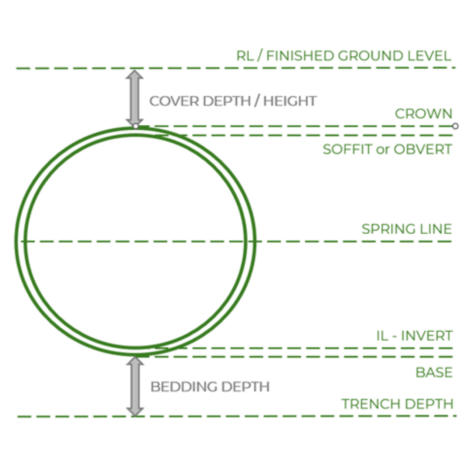
Solutions Summary
Table 1 INFRAPIPE Details
Precise weight is dictated by the load, cover depth and soil conditions, weight shown below is typical.
DN | ID | OD | Skt OD | Overall length mm | Effective length mm | Weight |
100 | 98 | 115 | 123 | 6490 | 6413 | 5 |
150 | 147 | 171 | 180 | 6461 | 6348 | 8 |
225 | 218 | 254 | 268 | 6429 | 6283 | 19 |
300 | 295 | 345 | 363 | 6389 | 6188 | 32 |
375 | 375 | 437 | 456 | 6390 | 6183 | 52 |
450 | 450 | 523 | 545 | 6340 | 6123 | 80 |
525 | 525 | 611 | 634 | 6317 | 6041 | 109 |
600 | 600 | 702 | 728 | 6273 | 5920 | 132 |
700 | 700 | 820 | 840 | 6000 | 5800 | 212 |
800 | 800 | 936 | 956 | 6272 | 5936 | 224 |
900 | 900 | 1090 | 1110 | 6000 | 5800 | 329 |
1000 | 1000 | 1166 | 1186 | 6283 | 5892 | 372 |
1100 | 1100 | 1320 | 1340 | 6000 | 5800 | 410 |
1200 | 1200 | 1464 | 1484 | 6000 | 5800 | 464 |
1350 | 1350 | 1614 | 1634 | 6000 | 5800 | 735 |
1500 | 1500 | 1776 | 1796 | 6000 | 5800 | 889 |
1600 | 1600 | 1800 | 1900 | 6000 | 5800 | 1126 |
1800 | 1800 | 2088 | 2108 | 6000 | 5800 | 1470 |
2000 | 2000 | 2310 | 2330 | 6000 | 5800 | 1878 |
2300 | 2300 | 2634 | 2654 | 6000 | 5800 | 2796 |
2500 | 2500 | 2842 | 2862 | 6000 | 5800 | 3395 |
3200 | 3200 | 3542 | 3562 | 3000 | 2800 | 2250 |
Standards
INFRAPIPE holds all the required standards:
- Certified to AS/NZS 5065:2005 licence no. AMI 74961.
- Pipes are tested by Infrapipe to AS/NZS5065:2005 in their test lab in accordance with ISO 9969:2016 Thermoplastic pipes – Determination of Ring Stiffness.
- The rubber rings are certified to EN681-1.
- INFRAPIPE Ltd is certified to ISO 9001:2015 licence no. AMI 78044.
Microplastics
To set the record straight, after extensive testing there is no proof (see article) that microplastics originate from thermoplastic pipes (the level of abrasion is simply too low). Line trimmers, clothing, food packaging and other consumer goods are typical sources of microplastics in the environment as they shed particles due to washing or cutting. Of greater concern for aquatic health is that the significant rate of abrasion from concrete pipes that contaminates the environment with cementitious particles.
Design Principles, Outcomes & Key Concepts
The Fish Passage Action Team (FPAT) identifies the following Principles and Outcomes of Fish passage design:
Fish passage principles at manmade structures & erosion control
Assuming it is agreed that there is fish habitat upstream, and sufficient water, fish passage mitigation/remediation interventions should subscribe to the following principles regardless of the species or life stage:
1st Principles (imperative for all species and life-stages)
- Provide sufficient depths and swimmable velocities or climbable surfaces.
- Ensure continuity of the steam bed – not perched or undercut.
- Maintain surface flow – avoid flow going sub-surface
2nd Principles (ideal)
- Create hydrological conditions (depth, velocity & complexity) akin to those occurring naturally upstream – this should provide passage for local fish species.
- Provide complex flows (various flow directions and velocities down through the water column) – giving a higher chance of meeting a range of fish migration needs.
- Provide rest pools – areas to rest and/or feed between high velocity zones.
- Provide a range of options, including wetted margins/splash zones – to cater to fish with a climbing ability.
3rd Principles (aspirational)
- Constrain flows and/or increase depth – maximise whatever water is available.
- Provide shade and cover – structural or vegetation.
- Retain bed material – without causing blockages.
Practice principles
- Avoid pouring concrete on site – it is highly toxic and prone to failure over time.
- Avoid dewatering existing structures for simple remediation – this is stressful for fish, costly, and requires permits.
Practitioners notes
- The diameter, gradient and length of the structure, along with site specific characteristics, will also determine the nature of interventions.
- The areas immediately upstream and downstream need to be considered, particularly if within the construction zone where ground has been broken.
Outcomes
Ecological Outcomes
- Fish and other aquatic organisms that arrive at the downstream end of a structure are able to migrate upstream to suitable habitat.
- Where practical, bed material accumulates and is retained within the structure providing both roughening and, to some degree benthic, habitat for fish and invertebrate communities.
- Maintain and manage flows to allow for passage for as many days as possible.
- If possible, provide habitat within structures e.g., provide shade, rest pools, refugia.
Engineering and Hydrological Outcomes
- Match or better the upstream flow characteristics – depth, complexity, velocity etc.
- Reduce exit velocities – prevent or reverse scouring and the creation of plunge-pools at the outlet.
- Maintain or improve water depth – maintain surface flow, constrain available flow without inducing fast laminar flows.
- Meet catchment capacity requirements – pipes of sufficient size to prevent overtopping in flood events.
- Meet load bearing requirements – culverts selected that will withstand design loads.
- Increase life of the structure – reducing abrasion/corrosion of the invert.
Overall
- Meet regulatory requirements – compliant across all regulations and consent conditions.
- Reasonable cost – within budget.
- Minimal maintenance – durable and robust.
- Minimal risk of blockage or failure – design to avoid long-term risk to asset.
Key Concept - Rest Pools
- Design for Fish Passage can be simplified to the need to provide a series of rest pools which suit local (desirable) fish which are linked by bodies of water with suitable flows which the fish can successfully navigate.
- A resting pool is an area that is deeper and slower than the flow would normally sustain and is long enough and deep enough that it can accommodate the desired local species through the greatest range of flows.
Key Concept - Flows
- Design for Fish Passage can be simplified to the need to provide a series of rest pools which suit local (desirable) fish which are linked by bodies of water with suitable flows which the fish can successfully navigate.
- A resting pool is an area that is deeper and slower than the flow would normally sustain and is long enough and deep enough that it can accommodate the desired local species through the greatest range of flows.
Key Concept – Drainage Requirements
- Any culvert is ultimately a drain – that is it must drain away liquid in order to function. Therefore, a culvert must:
Design Process
The following design process suggests the optimum information flow between the relevant specialists:
Table 2 Culvert Design Process
Ecologist | Hydraulic Engineering | Civil Engineering |
Provides Bank Full Width determination | ||
Provides swim velocities, swim endurance and minimum depths for desirable local fish. | ||
Provides flow rates for a range of flows | Provides possible Invert Level ranges at Inlet and Outlet Provides range of possible gradients | |
Determine Pipe Burial Level Determine Flow Velocities Determine Invert Levels Select Pipe Quantity and Size | ||
Show chord widths, water depths and mean flow velocities for a range of flow rates If required calculate average velocities for vertical slices | ||
Confirm Geotech (soil type and ground water level), load case and cover constraints | ||
Determine cover levels and therefore pipe strength (SN rating) | ||
Provide planting requirements and downstream/upstream requirements | ||
Design Inlet and Outlet areas Design headwalls, apron and trench | ||
Show longitudinal sections (and cross sections) of usable depths from fish perspective | ||
Confirm fish size and hence resting pool size | ||
Design fish baffle installation requirements | ||
1. Inlet
a. Inlet pool
b. Headwall/wingwall/inlet design
2. Pipe
a. Number & Size – Inner Diameter
b. Length(s) and connections
c. Design requirements or SN rating
d. Flexible fish baffles installed – size, spacing and offset
e. Flood gates installed
3. Outlet
a. Pool
b. The Invert Level should be below the downstream stream bed
4. Apron
a. This should be backwatered into the culvert
b. Mechanism for constraining low flows (to achieve backwatering)
c. Shading requirement
5. Resting pools should be sufficient in number in 1-4 above to enable progress of desirable local species
6. Surrounding area
a. Banks
b. Channels
c. Planting
7. Trench
a. Trench design – dimensions, bedding, embedment material, overlay zone and cover
8. Working area
a. Excavation
b. Permitted working area
c. Preparation for working area
d. Restitution
e. Access requirements
9. Temporary diversion
a. Diversion method
b. Diversion equipment
c. Diversion restitution
10. Erosion & Sediment Control Plan
11. Range of flows
Effective Fish passage design can be proven by demonstrating Invert levels and resting pools for the full range of flows anticipated.
Buoyancy is not an issue
Culverts are open-channel and therefore not affected by buoyancy. Whilst the profile of an INFRAPIPE can create buoyancy, the weight of even 300mm of cover is easily sufficient to overcome this.
Fish Passage Design
Hydraulic Performance
Not all pipes are created equal. Flow through gravity pipes is calculated using the Mannings formula, a part of which is the Mannings coefficient which makes allowance for the differing levels of surface roughness between materials.
For The NZ Building Code, NZTA and KiwiRail, the Mannings number used is 0.011 for plastic pipes and 0.013 for concrete. This is an average difference of 18% in hydraulic capacity (and up to 23%), often allowing the use of a smaller pipe to achieve the same flow rate.
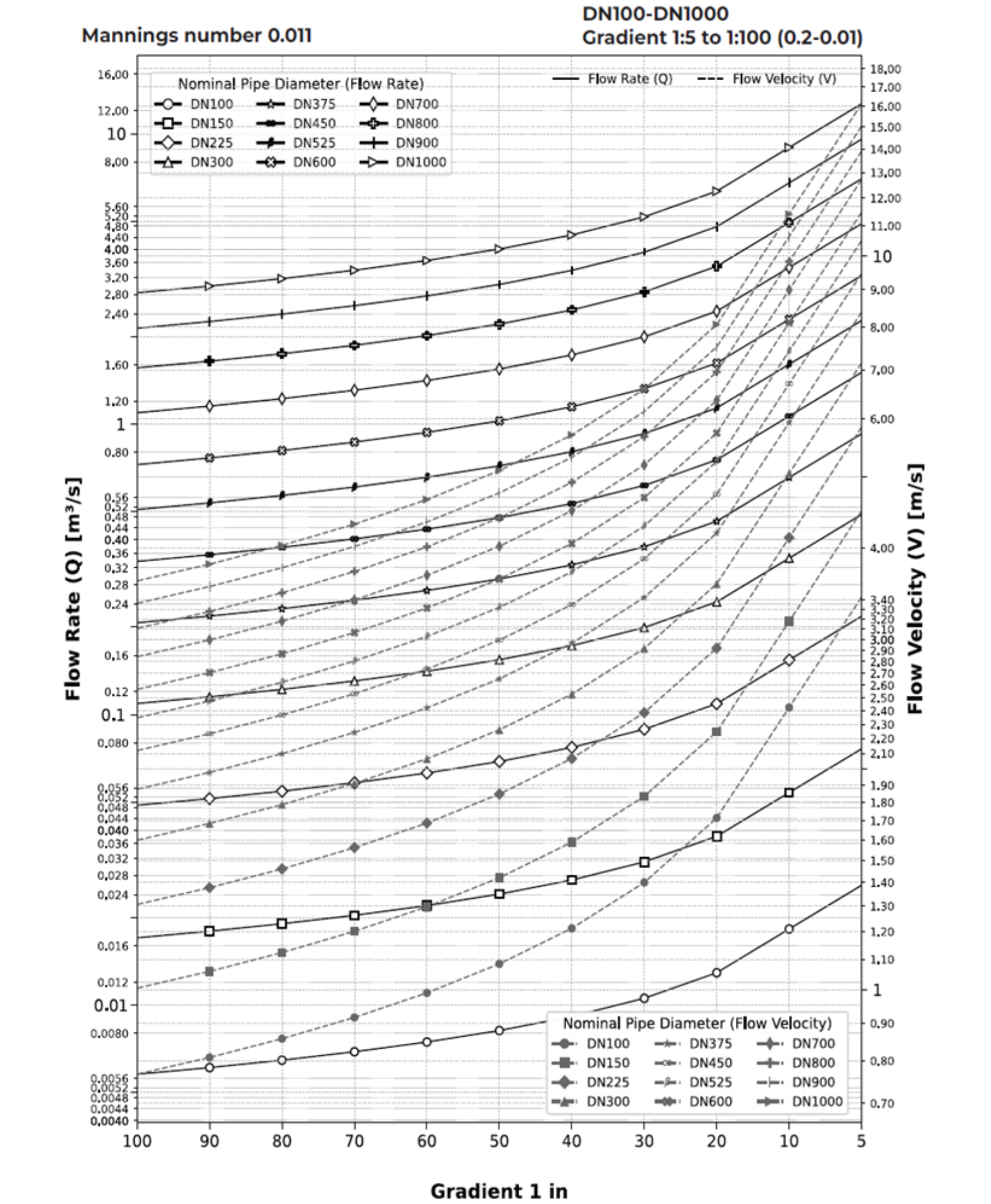
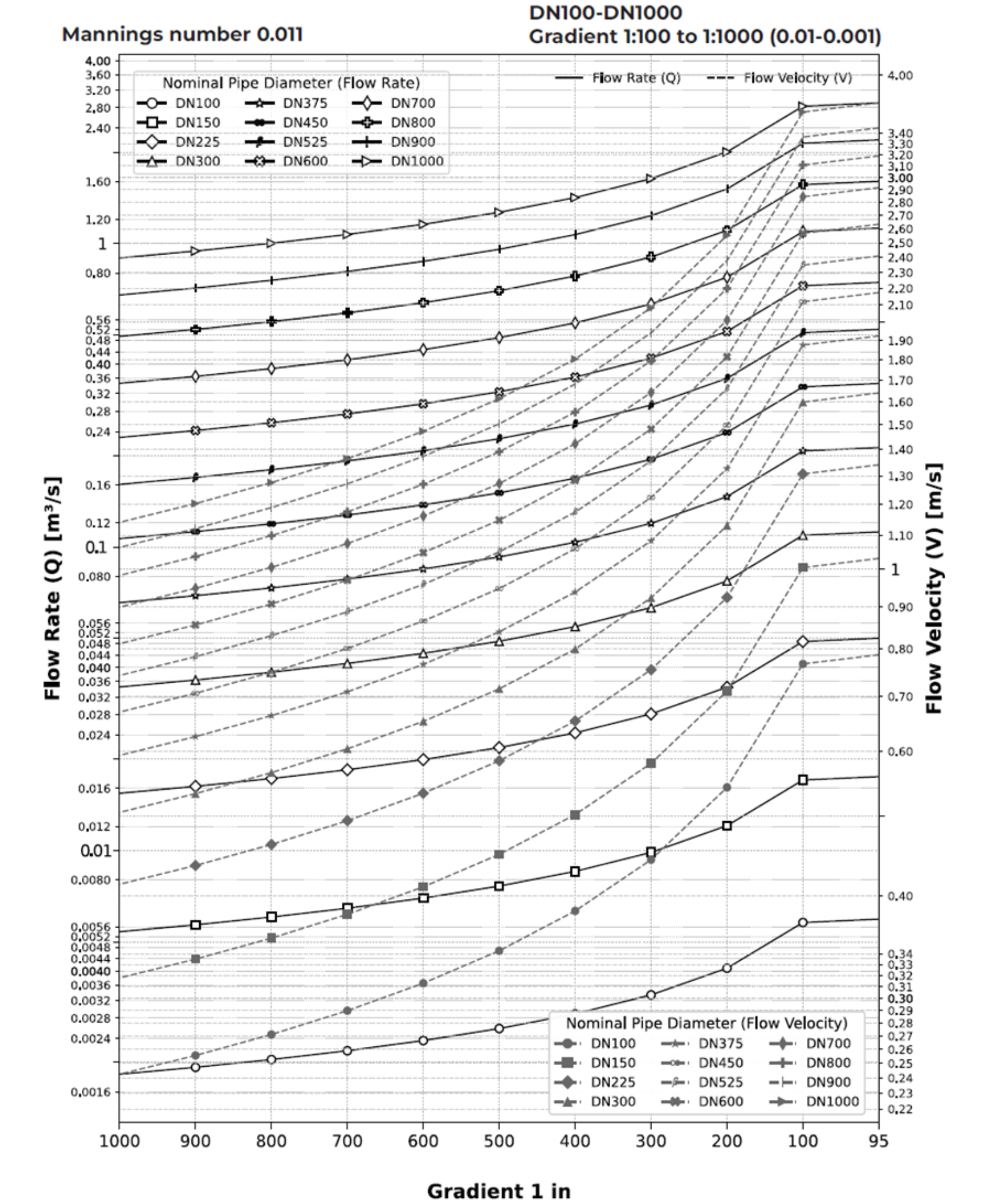
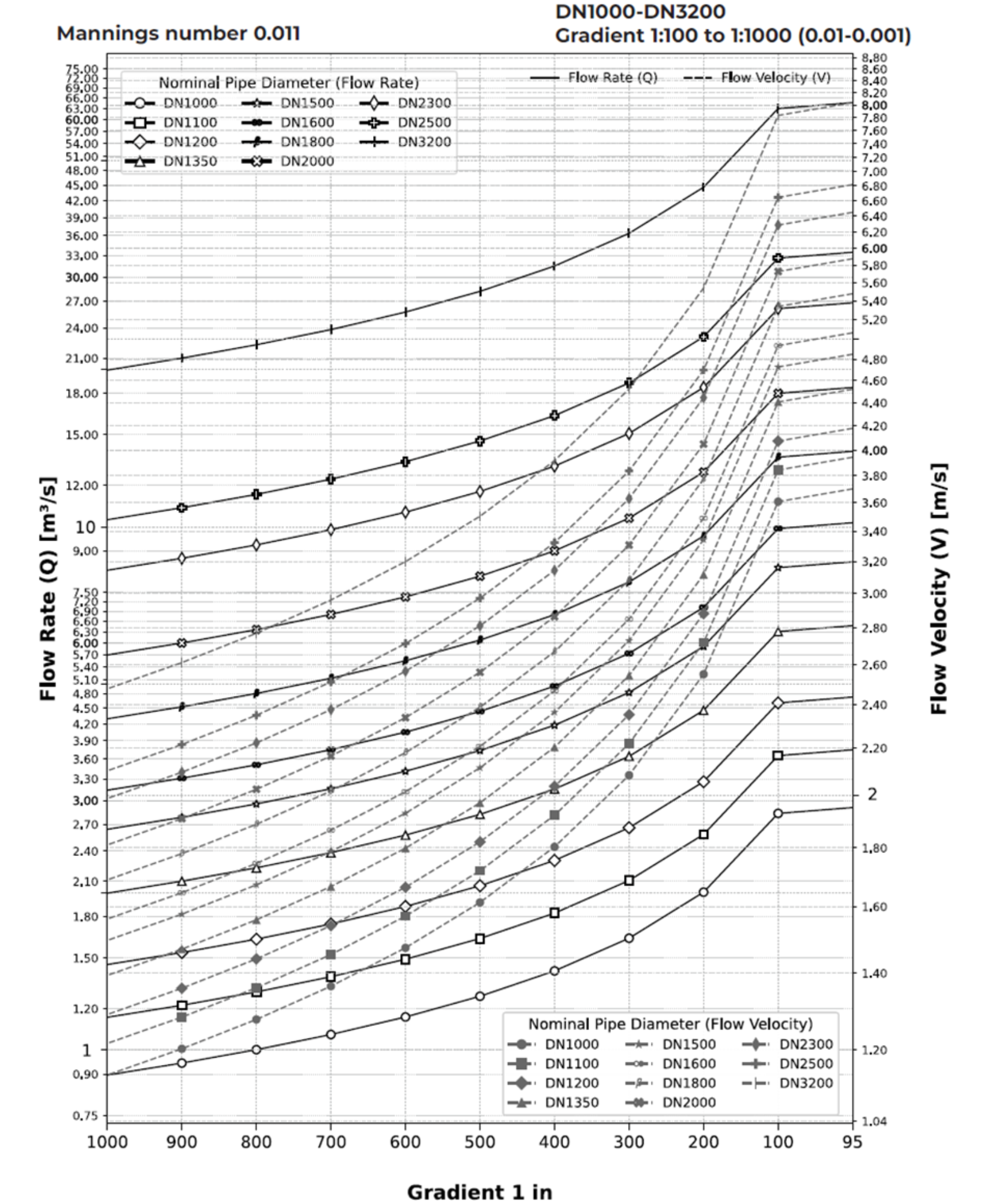
Mannings graphs for pipe selection are included at the end of this document.
Abrasion Resistance - Product Life (Darmstadt Test)
Abrasion reduces the efficiency of a pipe (and for concrete allows it to deteriorate, being friable). HDPE has the optimum abrasion resistance of any pipe material as proven in numerous tests:
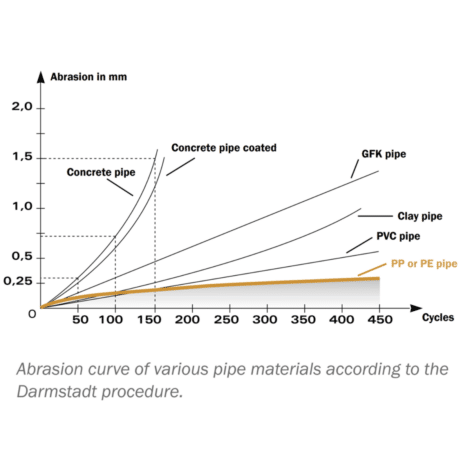
NB The above diagram is taken from a European paper, GFK is GRP/FRP (GRP is not used as a culvert in NZ).
The Darmstadt procedure, which has been the standard for abrasion testing since the 1960s, simulates the abrasion and resulting wear of liners and pipes that would occur in actual operating conditions by tilting a pipe section containing a mix of sand, gravel and water through 22.5 degrees above and below the horizontal for at least 100,000 cycles. The results for PP or PE pipe show a much greater resistance to abrasion and hence operating life is significantly longer.
The specimen comprises a 1metre length of DN300 pipe that is tilted to and fro in a controlled slow rocking motion at a frequency of 0.18 HZ; this corresponds to 21.6 stress cycles per minute – defined as the movement of the abrasive material in one direction.
This frequency ensures that the abrasion material travels the complete length of the test specimen. The abrasive material is a quartz sand and gravel in a water slurry containing approximately 46% by volume abrasive material in grain sizes 0-30mm. The abrasive material is changed every 100,000 stress cycles (approx. 77 hours).
Bank-Full Width (BFW)
INFRAPIPE pipes are denominated in their ID, therefore, to simply calculate the pipe (s) required to match the Bank-full Width, use the INFRAPIPE pipe size.
This can cause subsequent embarrassment, always confirm the ID of a pipe (see Diameters).
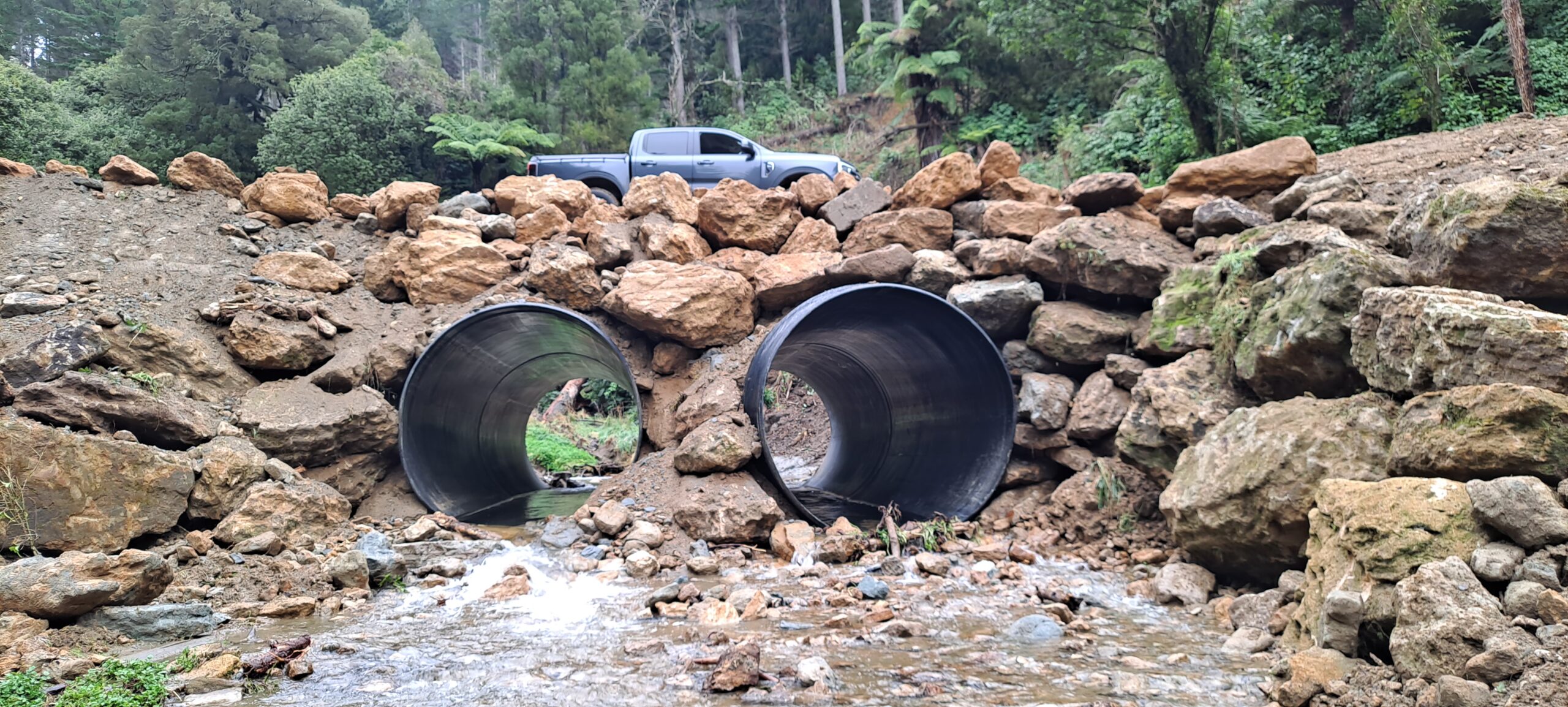
Twin Pipes & Multi-Barrelling updates in the latest Niwa Fish Passage Guidelines (FPG)
Previous iterations of the Fish Passage Guidelines stated that there was an ecological requirement to reduce the use of twin or multiple pipes where possible and encouraged the use of box culverts.
This frees up the designer to choose the optimum combination of pipes to suit the levels of the site, the hydraulic requirements and the Bank-Full Width requirements. Multi pipes offer lower profiles and a lower risk of blocking.
Single or multiple pipes?
At first glance, a single pipe sized to match the BFW appears the logical choice – and often is. However multiple pipe solutions offer a number of advantages in certain situations:
- The required levels above the watercourse are lower (as each pipe is smaller)
- The required disruption to the watercourse bed is lower (as each pipe is smaller)
- Blockage of one pipe still permits water to flow
- Installation water diversion can be easily achieved
- If appropriate, differing fish passage solutions can be offered in each pipe
- A combination of pipes and burial levels can allow optimum fish passage for different flows
- Overflow pipes can reduce the risk of scouring.
The weight of a box culvert can damage the site
A box culvert 1500mm high and 2500mm wide – a typical small installation – comes in sections that weigh 7.6 tonnes each. This is more than can be lifted by a digger. This page here explains the impact of the lifting distance on the actual weight to be lifted by the crane https://www.prestonhire.co.nz/a-guide-to-reading-a-crane-load-chart/ and this page then calculates this weight at distance https://www.cadmancranes.com/crane-size-calculator/ And the minimum equipment for this small box culvert then becomes this crane, for instance: https://www.cadmancranes.com/app/uploads/2022/08/TEREX-AC402L.pdf
The requirement for access, and for a stable lifting platform (with ground pads to allow for the stabiliser legs) dramatically increases the disruption of the site and ecological impact.
Burial Level & Chord Width Data
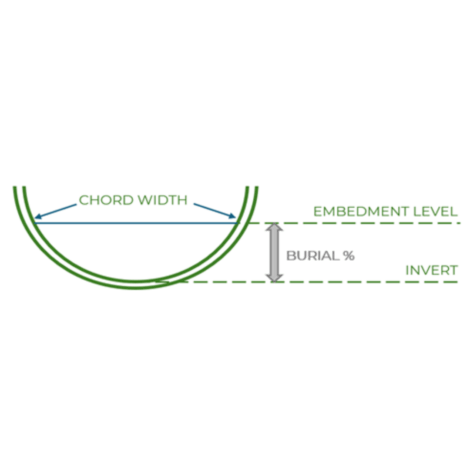
These tables assist the designer to see the cross sectional area and chord width for pipes when buried to certain levels. For intermediate requirements, contact [email protected]
Table 3 INFRAPIPE CROSS-SECTIONAL AREAS (CSA) IN MM FOR DIFFERENT BURIAL LEVELS
DN | % CSA remaining: Burial 0% | 86% 20% | 81% 25% | 70% 33% | 60% 40% | 50% 50% |
300 | 68,315 | 58,614 | 47,184 | 33,029 | 19,850 | 9,925 |
375 | 110,391 | 94,715 | 76,246 | 53,372 | 32,077 | 16,038 |
450 | 158,963 | 136,390 | 109,794 | 76,856 | 46,190 | 23,095 |
525 | 216,366 | 185,642 | 149,442 | 104,609 | 62,870 | 31,435 |
600 | 282,600 | 242,471 | 195,189 | 136,632 | 82,116 | 41,058 |
700 | 384,650 | 330,030 | 265,674 | 185,972 | 111,769 | 55,885 |
800 | 502,400 | 431,059 | 347,003 | 242,902 | 145,984 | 72,992 |
900 | 635,850 | 545,559 | 439,175 | 307,423 | 184,761 | 92,381 |
1000 | 785,000 | 673,530 | 542,192 | 379,534 | 228,100 | 114,050 |
1100 | 949,850 | 814,971 | 656,052 | 459,236 | 276,001 | 138,001 |
1200 | 1,130,400 | 969,883 | 780,756 | 546,529 | 328,464 | 164,232 |
1350 | 1,430,663 | 1,227,508 | 988,144 | 691,701 | 415,712 | 207,856 |
1500 | 1,766,250 | 1,515,443 | 1,219,931 | 853,952 | 513,225 | 256,613 |
1600 | 2,009,600 | 1,724,237 | 1,388,011 | 971,607 | 583,936 | 291,968 |
1800 | 2,543,400 | 2,182,237 | 1,756,701 | 1,229,691 | 739,044 | 369,522 |
2000 | 3,140,000 | 2,694,120 | 2,168,767 | 1,518,137 | 912,400 | 456,200 |
2300 | 4,152,650 | 3,562,974 | 2,868,194 | 2,007,736 | 1,206,649 | 603,325 |
2500 | 4,906,250 | 4,209,563 | 3,388,698 | 2,372,088 | 1,425,625 | 712,813 |
3200 | 8,038,400 | 6,896,947 | 5,552,042 | 3,886,430 | 2,335,744 | 1,167,872 |
Table 4 INFRAPIPE CHORD WIDTHS IN MM FOR DIFFERENT BURIAL LEVELS
Burial % | |||||||||||
DN | 5% | 10% | 15% | 20% | 25% | 30% | 33% | 35% | 40% | 45% | 50% |
300 | 129 | 177 | 211 | 236 | 255 | 270 | 277 | 281 | 289 | 295 | 295 |
375 | 163 | 225 | 268 | 300 | 325 | 344 | 353 | 358 | 367 | 375 | 375 |
450 | 196 | 270 | 321 | 360 | 390 | 412 | 423 | 429 | 441 | 450 | 450 |
525 | 229 | 315 | 375 | 420 | 455 | 481 | 494 | 501 | 514 | 525 | 525 |
600 | 262 | 360 | 428 | 480 | 520 | 550 | 564 | 572 | 588 | 600 | 600 |
700 | 305 | 420 | 500 | 560 | 606 | 642 | 658 | 668 | 686 | 700 | 700 |
800 | 349 | 480 | 571 | 640 | 693 | 733 | 752 | 763 | 784 | 800 | 800 |
900 | 392 | 540 | 643 | 720 | 779 | 825 | 846 | 859 | 882 | 900 | 900 |
1000 | 436 | 600 | 714 | 800 | 866 | 917 | 940 | 954 | 980 | 1,000 | 1,000 |
1100 | 479 | 660 | 786 | 880 | 953 | 1,008 | 1,034 | 1,049 | 1,078 | 1,100 | 1,100 |
1200 | 523 | 720 | 857 | 960 | 1,039 | 1,100 | 1,129 | 1,145 | 1,176 | 1,200 | 1,200 |
1350 | 588 | 810 | 964 | 1,080 | 1,169 | 1,237 | 1,270 | 1,288 | 1,323 | 1,350 | 1,350 |
1500 | 654 | 900 | 1,071 | 1,200 | 1,299 | 1,375 | 1,411 | 1,431 | 1,470 | 1,500 | 1,500 |
1600 | 697 | 960 | 1,143 | 1,280 | 1,386 | 1,466 | 1,505 | 1,526 | 1,568 | 1,600 | 1,600 |
1800 | 785 | 1,080 | 1,285 | 1,440 | 1,559 | 1,650 | 1,693 | 1,717 | 1,764 | 1,800 | 1,800 |
2000 | 872 | 1,200 | 1,428 | 1,600 | 1,732 | 1,833 | 1,881 | 1,908 | 1,960 | 2,000 | 2,000 |
2300 | 1,003 | 1,380 | 1,643 | 1,840 | 1,992 | 2,108 | 2,163 | 2,194 | 2,254 | 2,300 | 2,300 |
2500 | 1,090 | 1,500 | 1,785 | 2,000 | 2,165 | 2,291 | 2,351 | 2,385 | 2,449 | 2,500 | 2,500 |
3200 | 1,395 | 1,920 | 2,285 | 2,560 | 2,771 | 2,933 | 3,009 | 3,053 | 3,135 | 3,200 | 3,200 |
FISH PASSAGE FEATURES
Fish passage is included in design in two ways:
- The design of the site, its civil engineering, gradients, planting and inlet and outlets (sitework)
- The choice of the pipe, the baffle configuration and other requirements connected to the pipe (pipework)
Flexible Baffles
These flexible baffles are becoming the product of choice for the following reasons:
- They can be configured to suit – flexible in design as well as nature. This means:
- They can be spaced at the appropriate intervals for each site to create the resting pools required
- They can be used with any amount of offset for each baffle
- They can be used horizontally, vertically or part way between the two
- Their tapered design allows them to function in a wide range of flow rates
- They bend in stronger flows minimising the resistance to storm flows
- They are easy to attach to the culvert
- They are easy to attach to the culvert
- They do not retain debris
- They naturally allow some sediment to accumulate
- Individual baffles can be substituted/modified at any time should conditions change
- Factory fitted or site fitted (DN900+)
Flexible baffles are semi-rigid notched baffles (100 or 150mm high) which can be installed in all types of culverts and aprons and in any configuration. Whilst they can be retrofitted, factory fitting is cheaper, safer and, for diameters less than 900mm essential. INFRAPIPE works with the supplier of these baffles, ATS Environmental, to provide the best configuration for the ecological requirement.
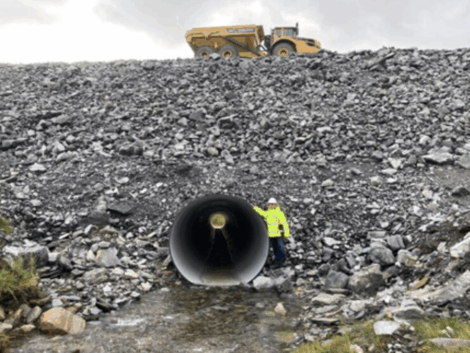
Table 5 Flexi-Baffle Lengths
FLEXI-BAFFLE LENGTH | |
Round culvert diameter | Length |
600mm>900mm | 450mm |
900mm>1200mm | 450mm |
1200mm>1800mm | 600mm |
1800mm>2400mm | 900mm |
2400mm>3000mm | 1200mm |
>3000mm | 1800mm |
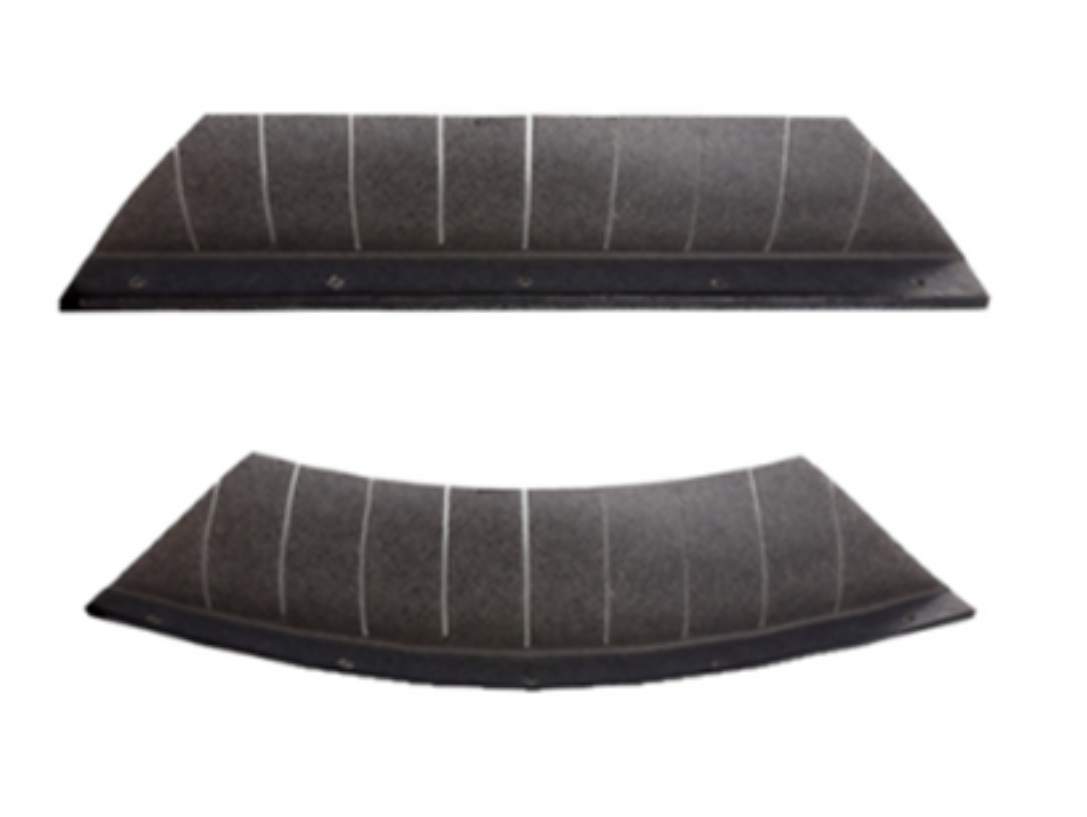
*150mm high baffles are also available and are suitable for flat bottom culverts and round culverts with a diameter over 1800mm.
Baffles are spaced so as to provide resting pools at an appropriate interval, the table below is a maximum distance between baffles to create effective resting pools. Should the desired fish species require closer spacing, the minimum spacing is 480mm but is typically 600mm or more:
Table 6 Flexible Baffle Spacing for a Given Gradient
Grade % | Degrees | Flexi-baffle spacing |
0 > 1 | 0 > 0.57 | 2400mm |
1 > 2 | 0.57 > 1.15 | 1200mm |
2 > 4 | 1.15 > 2.29 | 1000mm |
4 > 6 | 2.29 > 3.43 | 800mm |
6 > 8 | 3.43 > 4.57 | 600mm |
8 > 10 | 4.57 > 5.71 | 480mm |
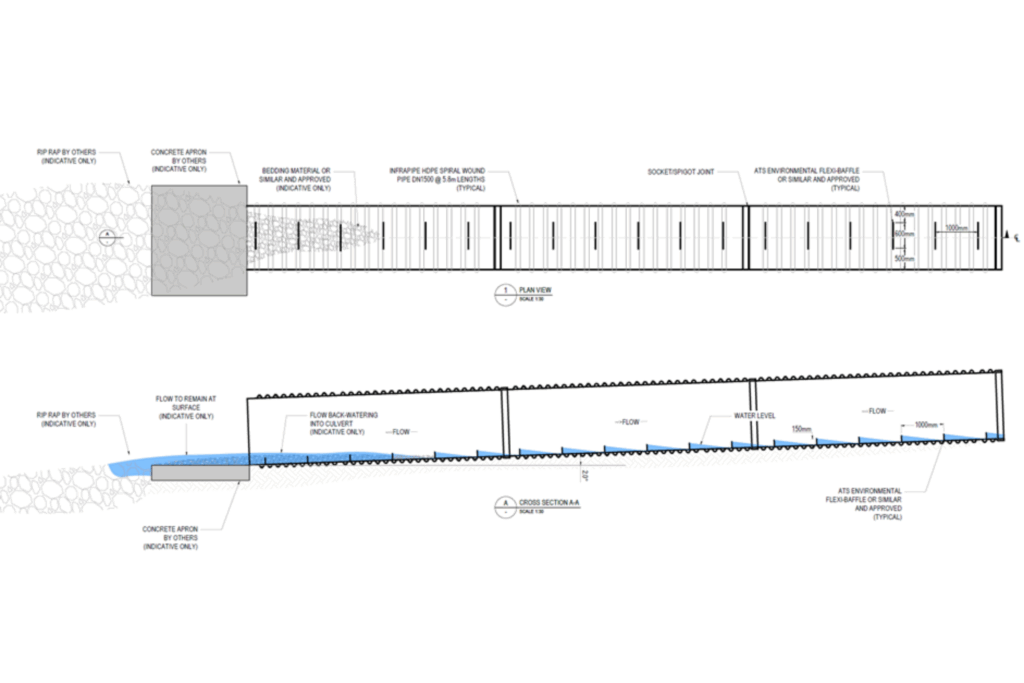
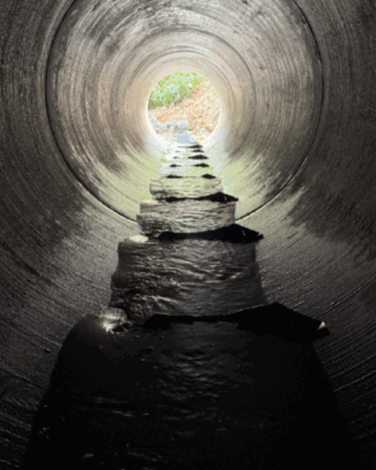
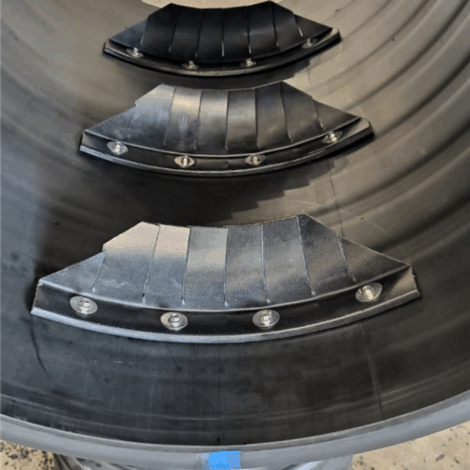
Offset flexible baffles on site creating resting pools and in the factory for installation.
For pipe sizes less than 600 (in the factory) or 900 (onsite), safe installation is achieved by baffles being affixed to a pipe liner (of the same diameter as the pipe) or PE strip which is then attached to the pipe at either end.
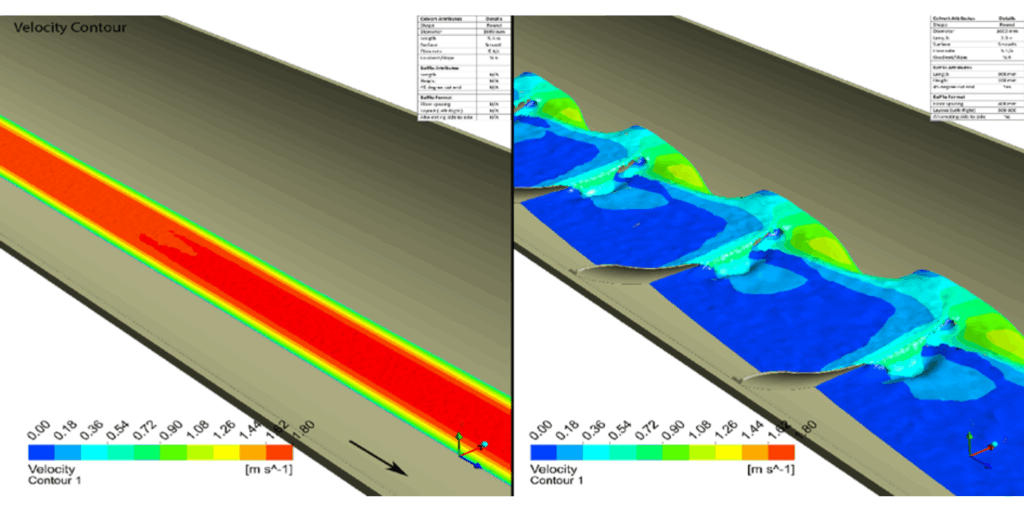
Fast, shallow, laminar type flows (in red) are not good for fish. Complex, deeper flow with rest pools (on the right) are great for fish. As the combination of gradients, target fish, and likely flow rates are unique to every site the flexibility of designing flexible baffle installation for each pipe ensures optimum fish passage for the greatest range of flows.
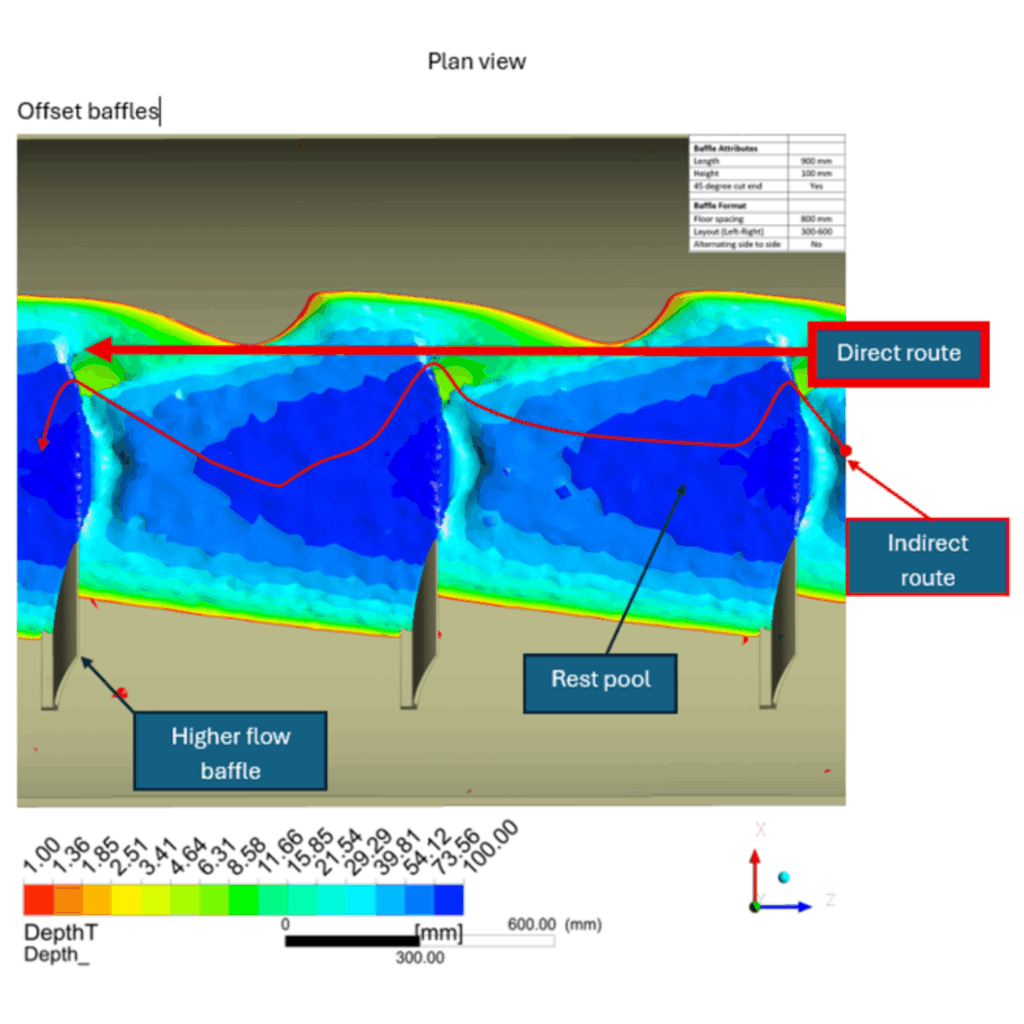
The CFD modelling shown above and below was recently undertaken by ATS environmental to prove the effectiveness of flexible baffles in achieving resting pools and complex flows to enable upstream navigation. It is reproduced from the Fish Passage Action Team’s Advisory Note 11072501 “New Culvert Installation”
FLOOD GATES
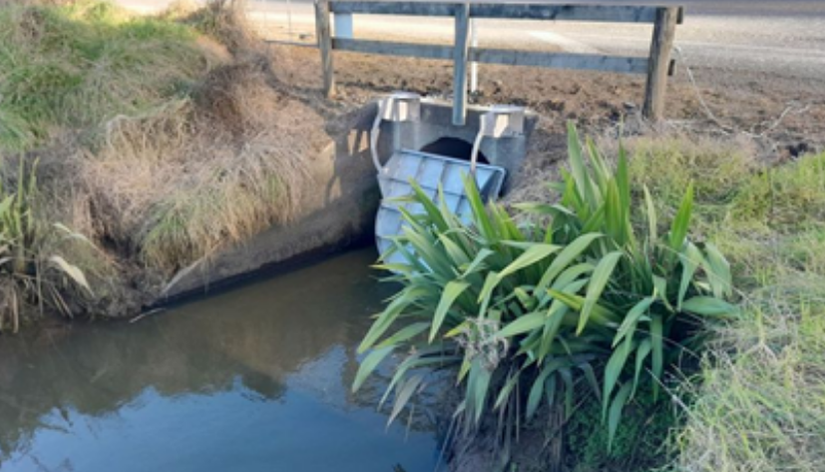
Fish-friendly flood-gates (for tidal or inland applications) are available and will be matched to the outfall and the pipe. INFRAPPIPE will co-ordinate this with the supplier, ATS Environmental. Their offset hinge allows upstream movement with low flows and can be configured for any desired range.
For more information on these solutions see ATS Environmental.
FLUMING
Fluming – which is half-sections of pipe used to divert or contain water flows – is also available for open channels and for diversion works. These can be used as a permanent channel and are ideal for situations where dewatering or other aspects of the site make a fast installation of the channel essential. These can also be factory fitted with flexible baffles and/or other fittings (to allow the subsequent siting of rocks for example).
LENGTHS AND JOINING
INFRAPIPE is normally joined with a rubber gasket (other options are available) and is available in 6m lengths (effective length 5.8m). However, for quicker install pipes can be supplied in 9m, 11.8m, 15m or 17.6m lengths or made to measure.
ANGLED INFALL/OUTFALL
HDPE can easily be cut and welded so if angled infalls or outfalls are required, the pipe can be supplied accordingly.
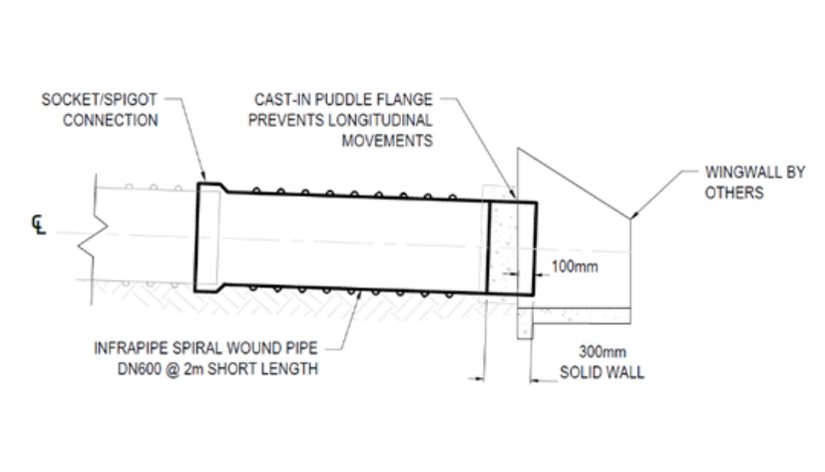
DELICATE ECOLOGIES – INTEGRATED HEADWALLS OR WINGWALLS
The use of toxic poured concrete on site can be avoided all together for delicate ecological systems by selecting pipes pre-installed into headwalls, wingwalls or apron structures. INFRAPIPE can provide more details such as the example to the right.
BENDS
There are situations where a bend is required in a culvert. For steel or concrete this has to be achieved with a manhole (which is not ideal for fish passage); INFRAPIPE has several options to provide a bend of any angle and any radius: (see Data Sheet here)
- Fabricated fittings to make exactly the bend required
- The pipe can be bent to a radius of 50 * the Inner Diameter (which may need anchor blocks)
- The pipe can be deflected a couple of degrees using flexibility in the socket and spigot.
DEWATERING CHAMBERS
Diversion of existing water flows or dewatering can require a chamber for settlement or catchment purposes. INFRAPIPE supplies pipes for this purpose to which the contractor can then add (if needed) a concrete base, perforations, penetrations for pump hoses and a lid. This chamber can then be cut up on site and returned as scrap to INFRAPIPE free of charge for recycling. See Data Sheet here.
OVERFLOW DRAINS
In situations where the width is constrained a second higher pipe can be used purely as an overflow in a Significant Rain Event. These overflow drains, being normally dry, need not comply with fish passage requirements and reduce the risk of scour or destruction/blocking of fish passage equipment such as baffles.
OVERLAND FLOW PATHS
Increasing the size of a culvert can significantly decrease the requirement for a secondary overland flow path (where this is required) which can offer the asset owner flexibility in design, savings in construction or both. Regional requirements vary but for instance Section 4.3.5.6 of the Auckland Council Stormwater Code of Practice states that:
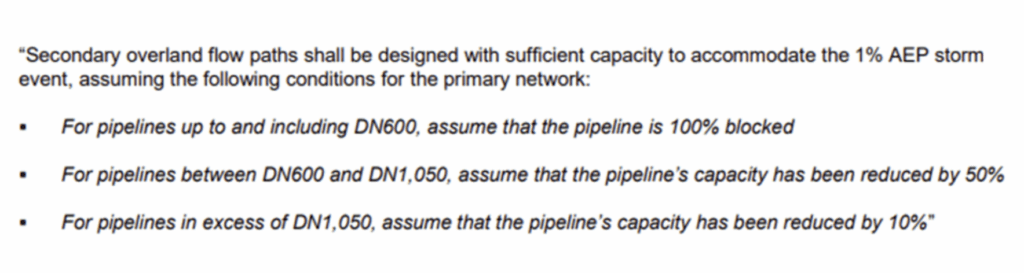
To put this into context, upgrading from a DN600 to DN700 has a typical additional pipe cost of $60/m, and from DN1000 to DN1100 $90/m which can lead to a substantial saving when compared to the potential costs of providing an overland flow path with sufficient capacity.
SUBSTRATE BAFFLES OR FALSE FLOOR
Where fish passage requires a given base level to the culvert and natural sedimentation may take too long, INFRAPIPE has two solutions:
For situations where the substrate must be either added prior to installation or encouraged to accumulate soon after commissioning to ensure fish passage, flexible baffles installed in the factory are the most effective solution. For designers who insist upon rigid substrate baffles, these can be installed in the factory. These are made of recyclable HDPE and can be made to any burial depth. Any spacing is possible and as a minimum they are installed before each socket and spigot (every 6m).
For situations where the correct base level needs to be guaranteed (such as high scour levels when sediment levels need to be maintained) INFRAPIPE can create an engineered solution for the specifics of the location.
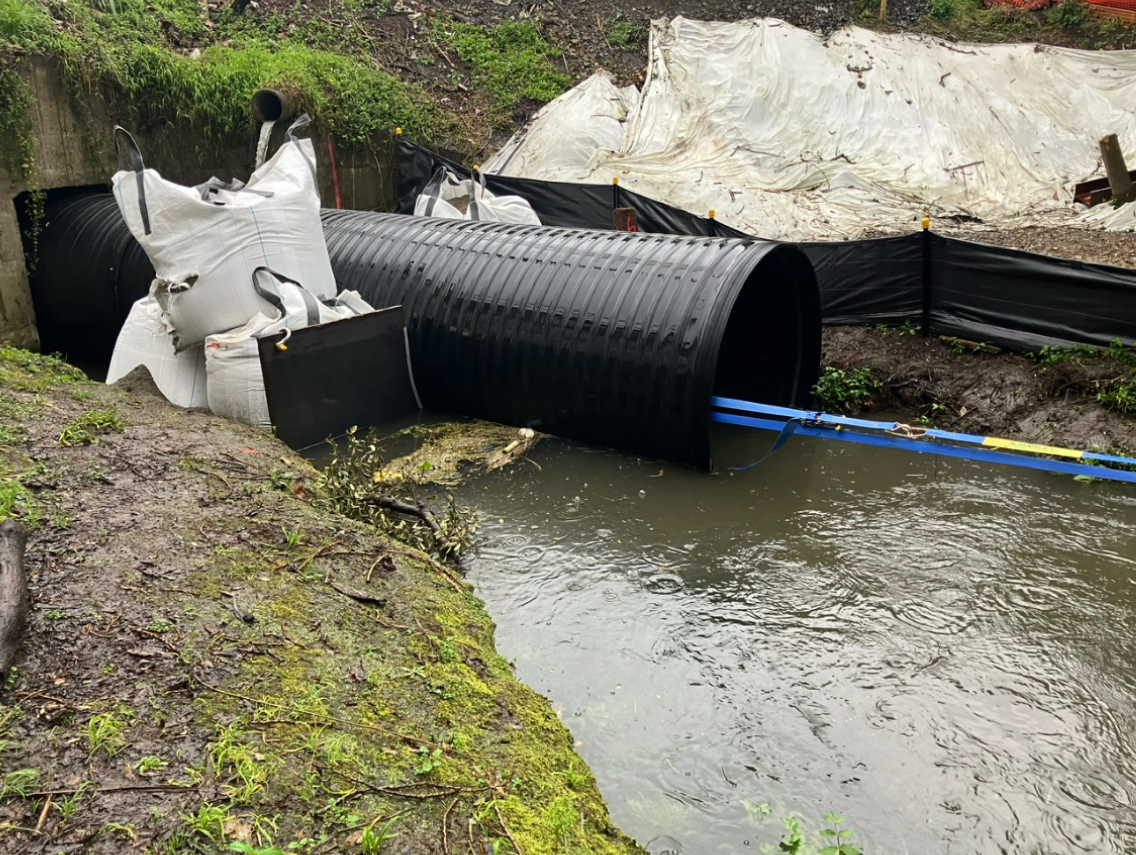
STREAM DIVERSION
INFRAPIPE offer special lightweight pipes for temporary works, smooth-skinned if they need to be dragged or inserted with flanges, sheets or other fittings to enable temporary headwalls or other fixtures.
The lighter the pipe, the less disruptive and the quicker the temporary measures need to be.
SUSTAINABILITY
HDPE/PP is the best material for the planet.
- Polyethylene/polypropylene has been repeatedly proven to have a 100yr+ life.
- Minimal erosion equates to minimal fugitive particles.
- Alternatives which are chemically attacked by the environment pollute the soil heavily.
- Alternatives which are susceptible to biological attack will decay and pollute.
- INFRAPIPE is completely recyclable. The asset owner has no end-of life disposal liability.
- All production waste is recycled.
- Lighter products require less freight, less cranes and less diggers.
- Lighter products use less global resources in their manufacture
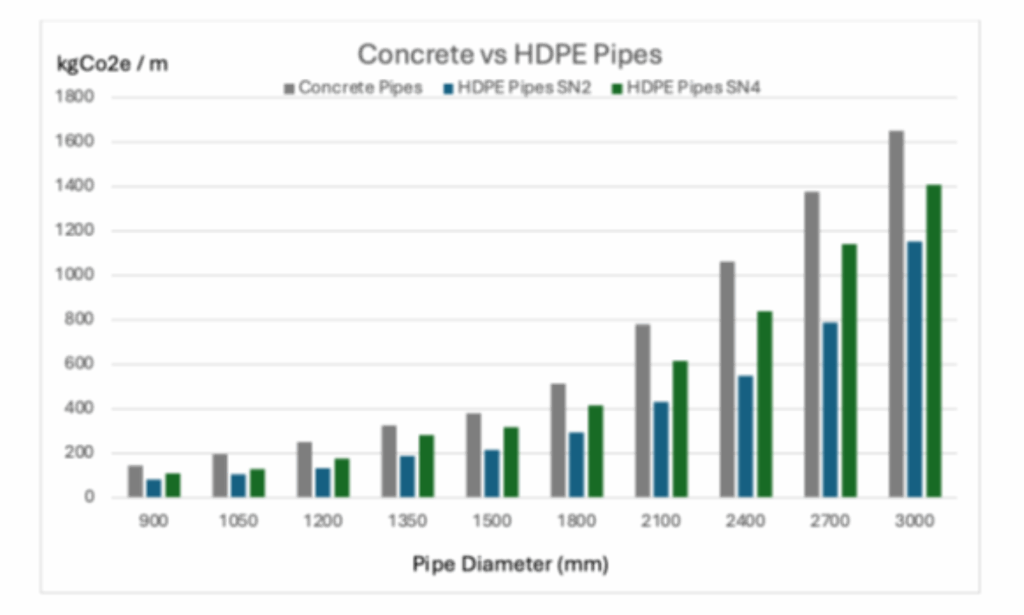
HDPE/PP has one-third (or less) the environmental impact of concrete and a longer life:
MANUFACTURE
- CO2/Pipe: HDPE pipes have a CO2/kg of approx. 2.2kg/m, where concrete is 0.25kg/m. However concrete pipes are 14 times heavier giving an equivalent CO2 figure of 3.5kg/m which is up to 60% higher than HDPE for cradle to gate depending on the product type.
- CO2/Metre: The improved hydraulic efficiency of thermoplastics allows smaller pipes for the same flow rate (typically 18%), further reducing the CO2 per metre of pipe.
- Production waste: All HDPE/PP production waste is reprocessed.
- No waste: INFRAPIPE is made to measure for large applications so there are no pipe ends or other waste. Manholes are made with connections so there is no waste from creating penetrations on site.
FREIGHT AND INSTALLATION
- CO2/Delivery: Pipes can be nested inside each other and being 14 times lighter, considerably less truck fuel is used.
- CO2/Installation: Smaller installation equipment is required for lighter pipes that are 2.5 or 5 times longer less time.
- EPDS from foreign manufacturers with identical equipment are available.
- Cradle to site the difference is even more pronounced due to the weight of concrete products.

(Graphs from “A New Comparative Analysis of the Environmental Performance Between Large Diameter HDPE and Concrete Pipes”, Dr Vasileios Samaras [Swansea Univ.] et al., 2025)
MAINTENANCE AND PRODUCT LIFE
- Chemical stability: HDPE/PP needs no maintenance where PVC and GRP/FRP degrade and become brittle. Thermoplastics are chemically inert.
- Wear resistance: HDPE/PP has the best abrasion resistance of any material and therefore the longest life.
- Product life: HDPE/PP is guaranteed for 100 years but concrete has no certainty of longevity because it interacts with the soil and the fluid being carried. Once concrete abrades, decays or reacts to a point where the reinforcing or cracks greater than 1mm are exposed, the asset manager should condemn and replace the pipe.
- Biological attack: HDPE/PP is immune to biological attack where concrete and GRP are vulnerable to it.
- Soil pollution: HDPE/PP does not react with the soil. If it is recognized that concrete reacts with some soil types (which it is, some councils even advise installing thicker pipes in anticipation of this) then to install concrete in any such location is an act of pollution in its own right.
- Seismic longevity: HDPE/PP has the best seismic resilience, minimizing the environmental impact of a seismic event – pipes do not need to be replaced or repaired and the consequences of any spills remediated.
- Damage/repair: HDPE/PP can be repaired quickly and easily with no pollution on site. Concrete and GRP require polluting epoxy solutions.
- Maintenance: HDPE/PP needs no maintenance of any form. As it is smoother than concrete, less debris or sediment will accumulate.
RECYCLING OR DISPOSAL
- Recycling: HDPE/PP can be exhumed at end of life and sold for recycling. There is minimal recycling of concrete or PVC and none of GRP in NZ.
- Recycled product: Recycled HDPE/PP product is used in rural culverts. Recycled concrete loses its strength and leaches into the soil heavily so has few real-world applications.
- Processing waste: All HDPE/PP is recycled, concrete pour-off, ends, knockouts etc. are typically buried.
- Disposal: There is no disposal cost with HDPE/PP, simply clean it and freight it. Concrete and GRP must be broken down and buried.
ENVIRONMENTAL PRODUCT DECLARATIONS
The EPDs of other users of the same KRAH (profile pipe) equipment as INFRAPIPE have EPDs available to prove the figures above:
- Visit EPDHUB and use the code HUB-0168 for the larger, helical wound pipes DN1200+
- TEPPFA (the European Pipe Body) produced an EPD for the smaller twinwall pipes DN300-1000
- TEPPFA EPD for CIVILPIPE equivalent for the smaller twinwall pipes DN300-1000
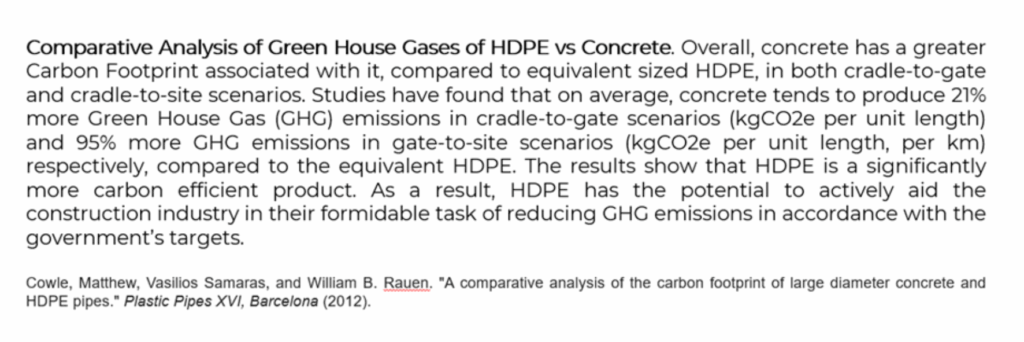
There are numerous articles available to confirm the benefits such as this:
PRODUCT LIFE & MATERIAL QUALITIES
MATERIAL LIFE – PRODUCT LIFE
The latest meta study by TEPPFA confirmed that the expected life of HDPE pipes is well in excess of 100 years. This is in addition to the 2006 research conducted on pipes exhumed after 50 years in the ground which confirmed their service life will exceed 100 years, or the study conducted in 2014 which investigated a wide variety of pipes to confirm their service life was 100 years plus.
INFRAPIPE guarantee their pipe for 100 years. Concrete is only guaranteed for 7 days.
MATERIAL CHOICE
Historical culvert material choices were between concrete, steel, SRP or thermoplastics (HDPE).
Steel is not included in the table below because it is so expensive, so heavy, so prone to corrosion and buckling that it is no longer used in new installations. PVC is shown below but becomes cost-prohibitive over 300mm and has no advantages over more economical HDPE, and is UV resistant, heavier and more brittle.
SRP (Steel Reinforced Plastic) is not included in the table below because it is a legacy technology before HDPE pipes in larger sizes became available. Whilst SRP has the flow characteristics of HDPE, it does not have the flexibility or buckling resistance reducing the longevity for no gain.
While concrete is shown below as many contractors will attempt to revert to concrete as they gain more from it, it is less hydraulically efficient by 18% (see below), has appalling abrasion resistance and because it chemically reacts with the soil its life is not guaranteed where HDPE is guaranteed to last 100 years.
Table 7 Comparative material properties
Requirement | HDPE/PP | Concrete | PVC |
Material life | Very good | Average | Good |
Abrasion resistance | Very good | Very Poor | Good |
Hydraulic efficiency | Very good | Average | Very good |
Weight | Light | Very heavy | Heavy |
Tensile Strength | Very good | Good | Average |
Compressive Strength | Good | Very good | Good |
Ductility | Very good | Nil | Nil |
Deformation Recovery | Good | Nil | Nil |
Brittleness | No | Some | Yes |
Homogeneity | Yes | Yes | Yes |
Risk of infiltration | Very good | Very poor | Poor |
Ease of modification | Very good | Average | Average |
Ease of repair | Very good | Average | Poor |
Seismic resilience | Very good | Poor | Average |
Water permeability | Very good | Poor | Very Good |
Biological resistance | Very good | Poor | Very Good |
Chemical resistance | Very good | Very poor | Good |
Recycled in NZ | Very Good | Rare | Rare |
Sustainable manufacture | Average | Poor | Very Poor |
Sustainable installation | Very Good | Average | Average |
SEISMIC RESILIENCE
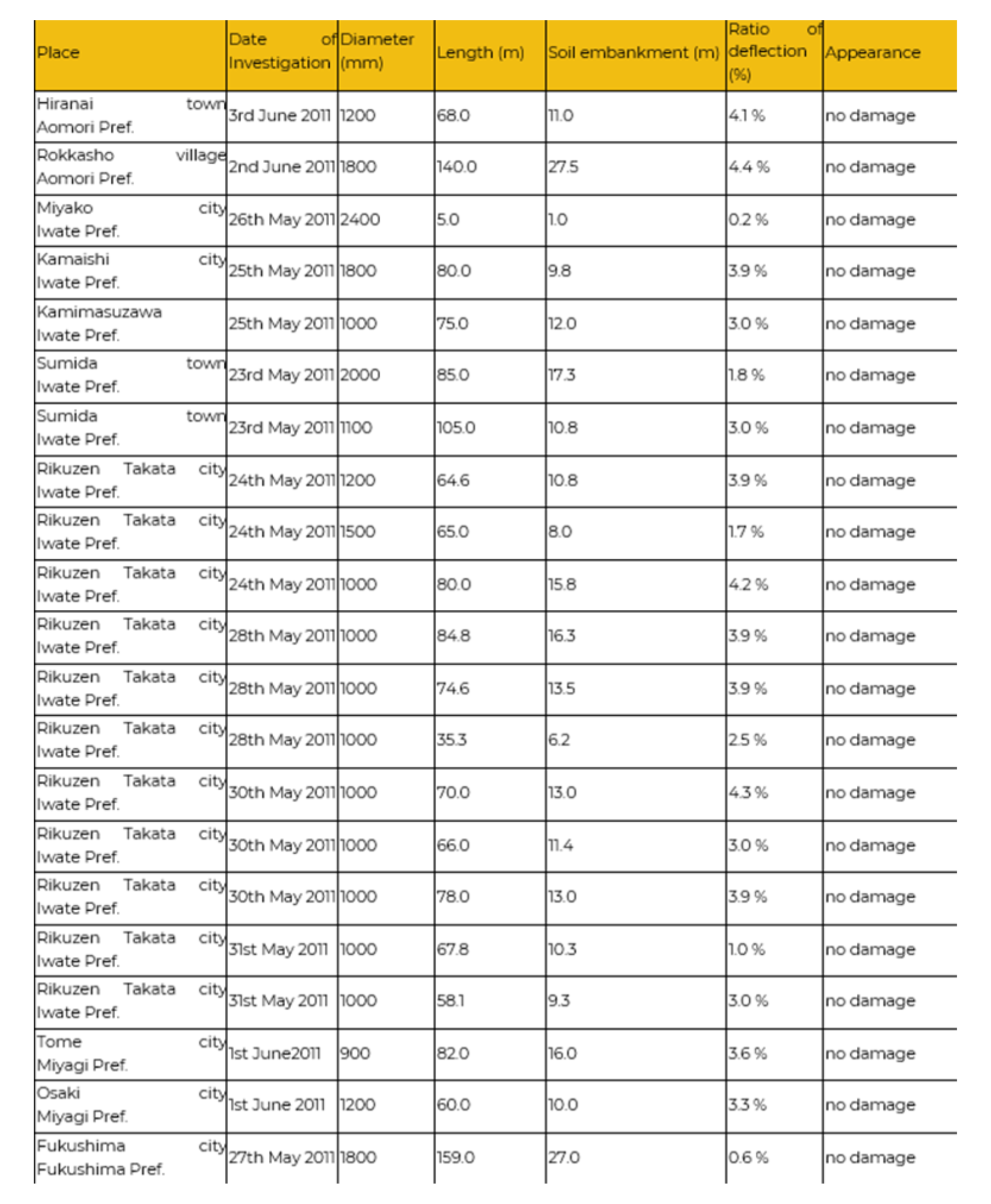
HDPE pipes and tanks have high flexibility allowing them to absorb seismic energy without breaking or cracking unlike more rigid alternatives. The ductile nature of HDPE allows the structure to deform without breaking, allowing pipes to stretch and elongate rather than fracture (elongation can reach 600%) After the Japanese earthquake of 2011, all the HDPE KRAH pipes (the same as INFRAPIPE) in the area were surveyed and none found to be damaged:
Table 8 Results of profile pipe survey after Japanese earthquake of 2011
For the layman, plastic pipes bend or stretch with the forces of an earthquake. If left unsupported or floated by liquefaction or soil displacement, their flexibility prevents rupture and disaster. A plastic pipe recovers its shape after damage (see these videos) so if the whole structure is affected by an extreme event, the pipe can be rebuilt by rejoining the sections on site.
INSTALLATION
SPEED OF INSTALLATION
Diversion, dewatering and ecological monitoring all create significant daily costs. INFRAPIPE is the fastest option to install for these reasons:
- It is lightest
- It joins quickly
- It can be supplied in longer lengths
- It is safer for staff to work in the trench with the pipe
Fish baffles etc. can be provided factory fitted or for site installation
CONSEQUENCES OF INSTALLATION
Environmental stewardship requires two outcomes:
A DN600 concrete pipe weighs 318 kg per metre. The equivalent INFRAPIPE weighs 23 kg per metre. The impact on the site is significantly less with INFRAPIPE.
Heavier pipes (14 times heavier) cause greater ecological damage because they require:
In addition to the above ecological consequences, concrete pipes can also have these additional demands:
COVER DEPTHS AND LOADS
The standard cover depths for different loads are shown below, INFRAPIPE can manufacture the exact strength (and length) pipe for each location, minimising the resources consumed.
- For situations outside the above or depths of 6m+, contact INFRAPIPE for an engineered solution.
- More detail can be found in AS/NZS 2566.1:1998 Buried Flexible Pipelines: Structural design and AS/NZS 2566.2:2002 Buried flexible pipelines – Installation.
Table 9 Cover depths and loads for INFRAPIPE
Loading condition | mm | Loading condition | mm |
Not subject to vehicles | 300 | Vehicle load no carriageway | 450 |
Land zoned for agricultural use | 600 | Vehicle load unsealed carriageway | 750 |
In embankments or construction eqpt loads | 750 | Vehicle load sealed carriageway | 600 |
MANNINGS GRAPHS FOR CULVERTS
For each Mannings number the tables are split by gradient:
- One for extreme gradients from 1:5 to 1:100 (0.02 to 0.1), the other for 1:100 to 1:1000 (0.01 to 0.001)
For each gradient group there are then two tables:
- Firstly DN100:DN1000, then DN1000-DN3200
Starting with a flow rate and gradient, trace up the gradient line to intercept the flow rate and select the pipe size (solid line) above it. To obtain the flow velocity, then follow the gradient up to the dashed line for that pipe size and read the flow velocity. For more details see INFRAPIPE Mannings Graphs here.
NZ Building code, NZTA & KiwiRail all specify Mannings n of 0.011 for HDPE and 0.013 for concrete.
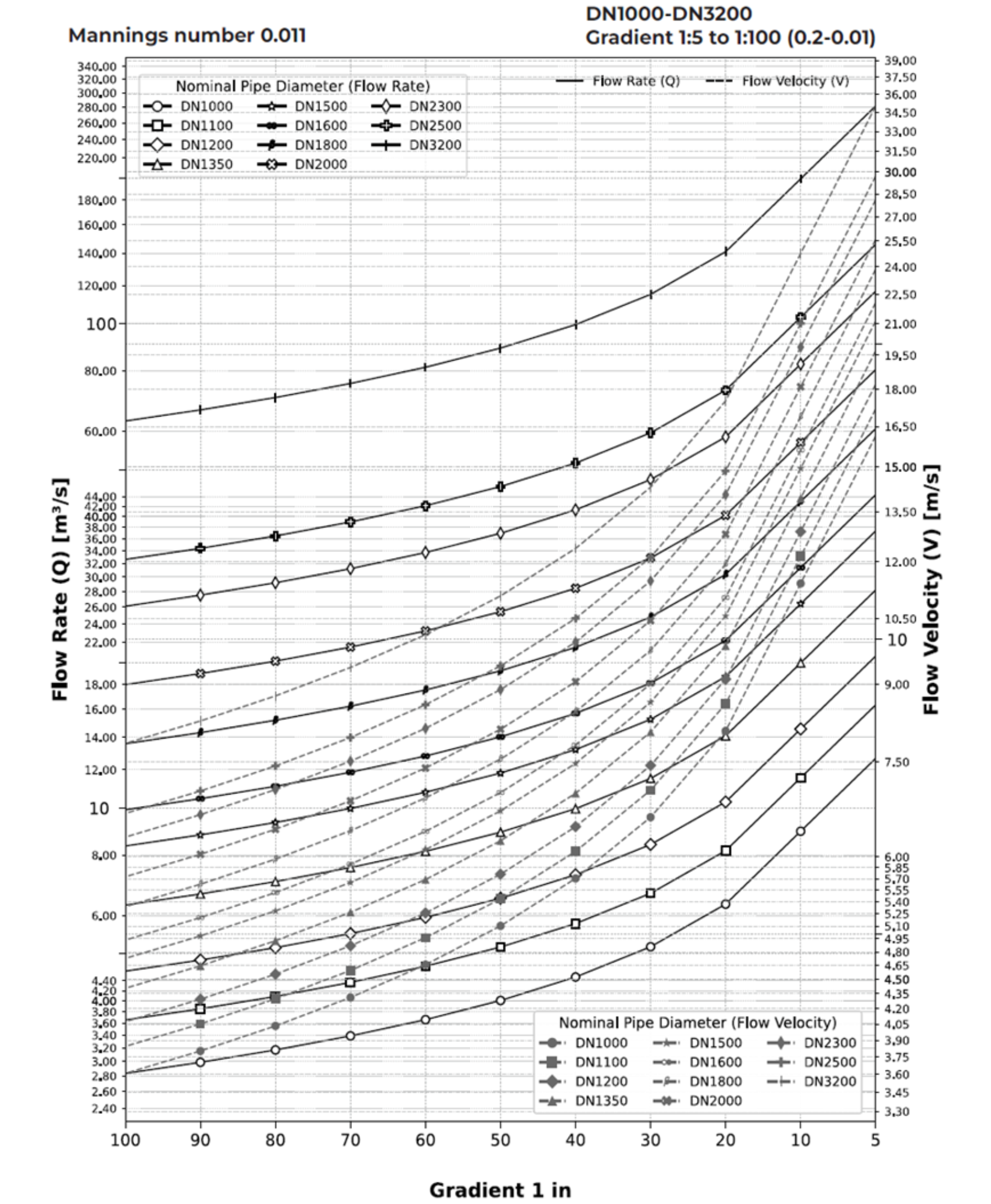
Massively! The reduced drag from the effects of the perimeter improves the hydraulic performance substantially – in the examples here, the HDPE DN3200 at 1:100 achieves a flow rate per m² of cross-sectional area of 9.75 (m³/s per m²) as opposed to 8 for the DN2500. Note also the 20%+ increase in performance from the smoother HDPE to the rough concrete!
Flow Rate m3/s | 1:200 | 1:100 | |
HDPE Mannings 0.011 | DN3200 | 54 | 78 |
DN2500 | 28 | 40 | |
Concrete Mannings 0.013 | DN3200 | 45 | 64 |
DN2500 | 23 | 33 | |
Table 10 Flow rates for a given gradient, ID and material
Contact us
Contact Us
INFRAPIPE

