


Is INFRAPIPE better than concrete?
The purpose of a pipe is to convey fluids and have as long an operational life as possible.
CONCRETE PIPE HAS 18% LESS HYDRAULIC CAPACITY
Due to the roughness of the material (especially once abraded, see below), concrete pipe provides a flow rate that is 18% less than thermoplastics (HDPE, PP) such as INFRAPIPE, CIVILPIPE, PKS pipe, BOSSPIPE. This is expressed in the Mannings number – a coefficient used in hydraulic calculations for gravity flow.
NZTA, KiwiRail, Auckland Council and other asset managers require Mannings of 0.013 for concrete and 0.011 for plastic
Pipe volume increases exponentially so the 18% difference translates to a requirement to use a bigger concrete pipe between 40% (smaller pipes) and 70% (larger pipes) as shown by the diagram below.
A larger pipe increases pipe and trench cost by 20-25%

CONCRETE PIPE HAS A SHORTER LIFE THAN PLASTIC PIPE
Whilst nominally concrete pipe also has a service life of 100 years like INFRAPIPE, CIVILPIPE, PKS pipe & BOSSPIPE, in the real-world concrete suffers from abrasion at a rate 5 times greater than plastic pipes and even when allowing for the differing wall thicknesses, a concrete pipe will only last 70% as long as a plastic pipe for the same abrasion levels.
Nor do plastic pipes crack, rust or react with the soil and the fluids they convey ensuring that their real-world lifespan actually is 100 years. The first plastic pipes have been in the ground for 70 years now and analysis of their performance confirms that their material has a greater longevity than required to last 100 years.
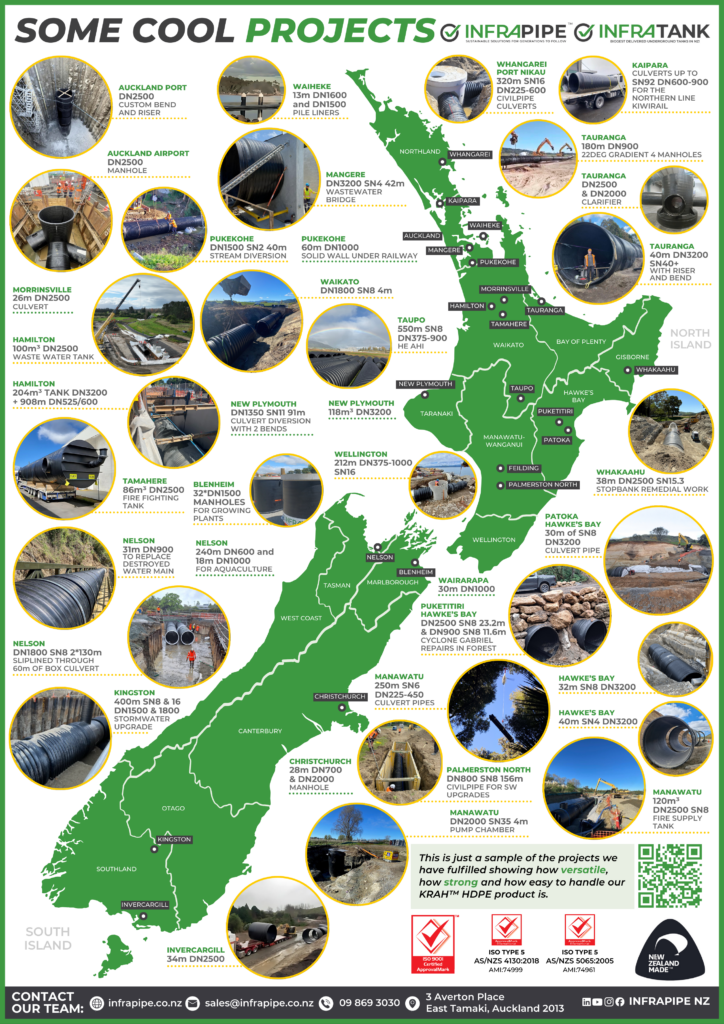
Infrapipe - Projects Map
- Click the image to download the map.
Contact us
Contact Us
INFRAPIPE

